
Sustainability across environment, people, and governance
BMH Technology is one of the global leaders in sustainable waste refining and solid biomass handling systems. The company’s vision is to create solutions for waste to be reborn as raw materials and renewable energy. BMH Technology designs and delivers plants, equipment, and aftersales services worldwide to help customers recover materials, decrease landfill waste, and reduce CO₂ emissions.
The sustainability work of BMH Technology follows the ESG framework, covering environmental responsibility, social responsibility, and governance. Together with our customers, we build a renewable future by being part of the transition and enabling higher recycling rates across the industries we serve.
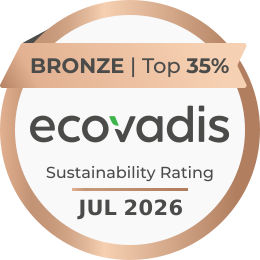
Our sustainability work is guided and validated by international frameworks. BMH participates in the EcoVadis assessment annually and is currently awarded the Bronze medal, placing us among the top 35% of companies assessed globally. We have identified the UN Sustainable Development Goals where BMH can create the greatest positive impact, and those where we work to minimise any negative impact.
From the beginning of 2026, BMH has also committed to the UN Global Compact and its ten principles on human rights, labour, environment, and anti-corruption.
Independently assessed by EcoVadis
EcoVadis is a globally recognised sustainability rating platform that assesses companies across four areas: environment, labour and human rights, ethics, and sustainable procurement. Its ratings are widely used in industrial supply chains as an independent benchmark of corporate sustainability performance and transparency.
BMH participates in the EcoVadis assessment annually. We are currently awarded the Bronze medal, placing us among the top 35% of companies assessed globally.
Certified across quality, environment, and safety
BMH Technology’s operations are certified to three international ISO standards, independently audited and renewed regularly. These certifications cover the quality of our work, our environmental management, and the occupational health and safety of our operations. View and download our certificates:
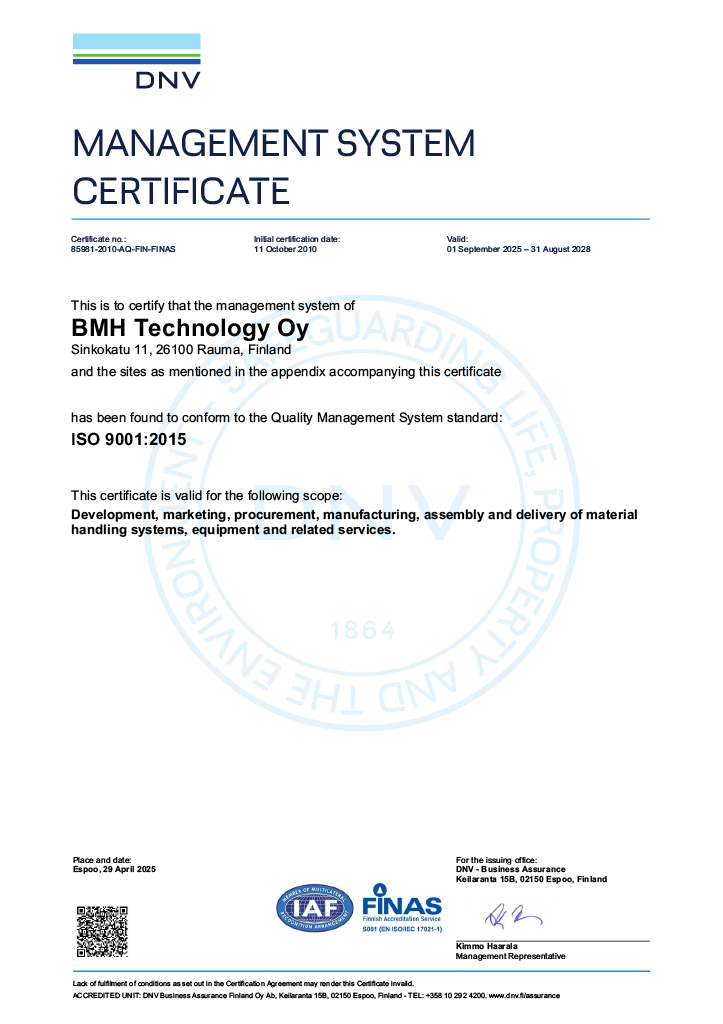
ISO 9001:2015 – Quality management
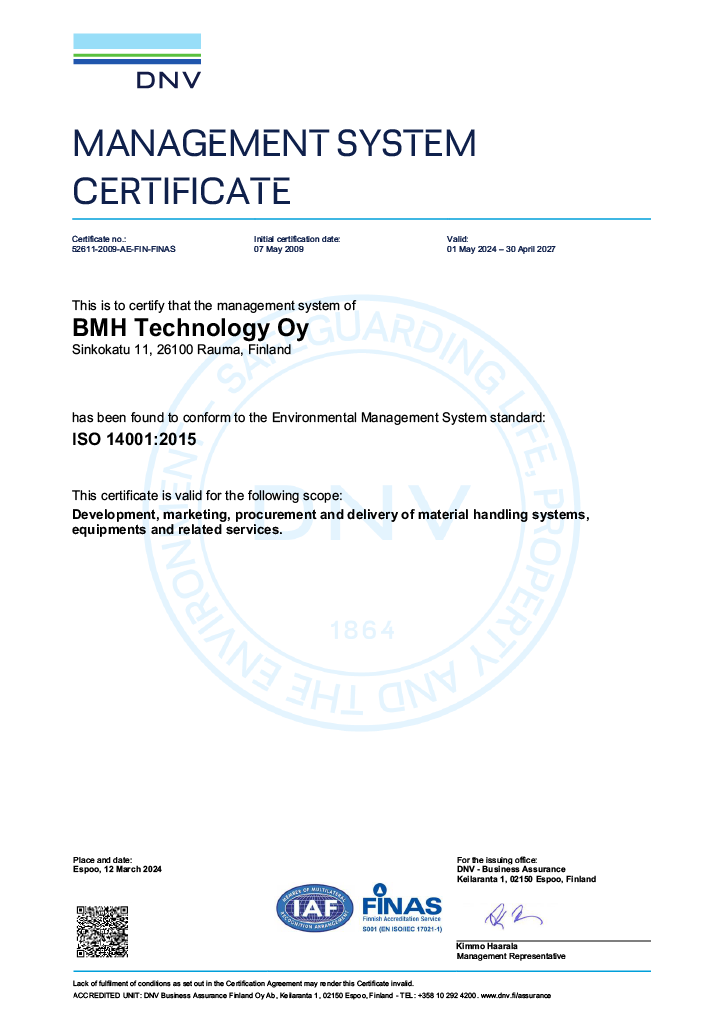
ISO 14001:2015 – Environmental management
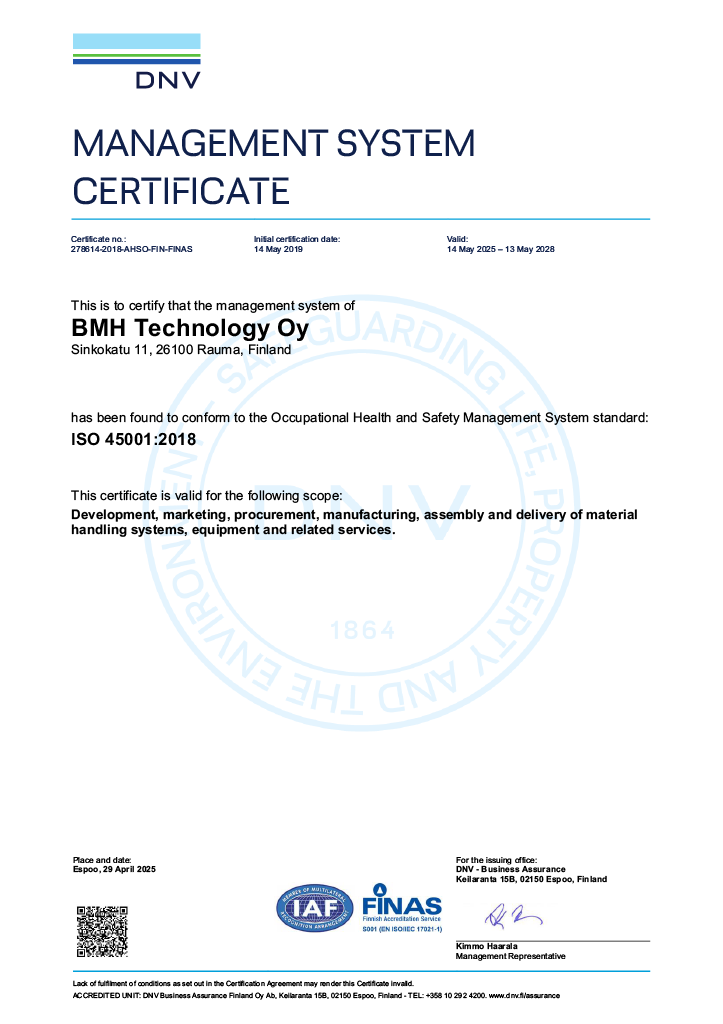
ISO 45001:2018 – Occupational health and safety
Our operations are guided by BMH’s Operational Policy and the requirements of our stakeholders.
BMH Code of Conduct
Our Code of Conduct sets the ethical framework for how BMH operates, covering our values, business principles, and expectations for social and environmental responsibility.
Reducing emissions from our own operations
BMH measures its greenhouse gas emissions using the internationally recognised GHG Protocol, which divides emissions into three scopes: direct emissions from our own operations (Scope 1), indirect emissions from purchased energy (Scope 2), and emissions across our value chain (Scope 3).
Emissions are measured as GHG intensity, meaning tonnes of CO2 equivalent per million euros of turnover. Our baseline year is 2019. Alongside intensity, we also measure and monitor our absolute emissions.
Scope 1 and 2: -53% reduction, target exceeded
Emissions are measured as GHG intensity using 2019 as our baseline year of 6.57 tCO2e/M€. Our target for 2025 was a -40% reduction, and we have exceeded our target with a -53% reduction.
Scope 1 and 2 cover direct emissions from our own operations, mainly at our workshop including fuels, district heating, and purchased electricity. The most significant reduction has come from switching our workshop electricity contract to certified renewable electricity. In addition, we have replaced fuel-driven equipment with electric alternatives and invested in more energy-efficient equipment such as a new compressor.
Safety and well-being of our people
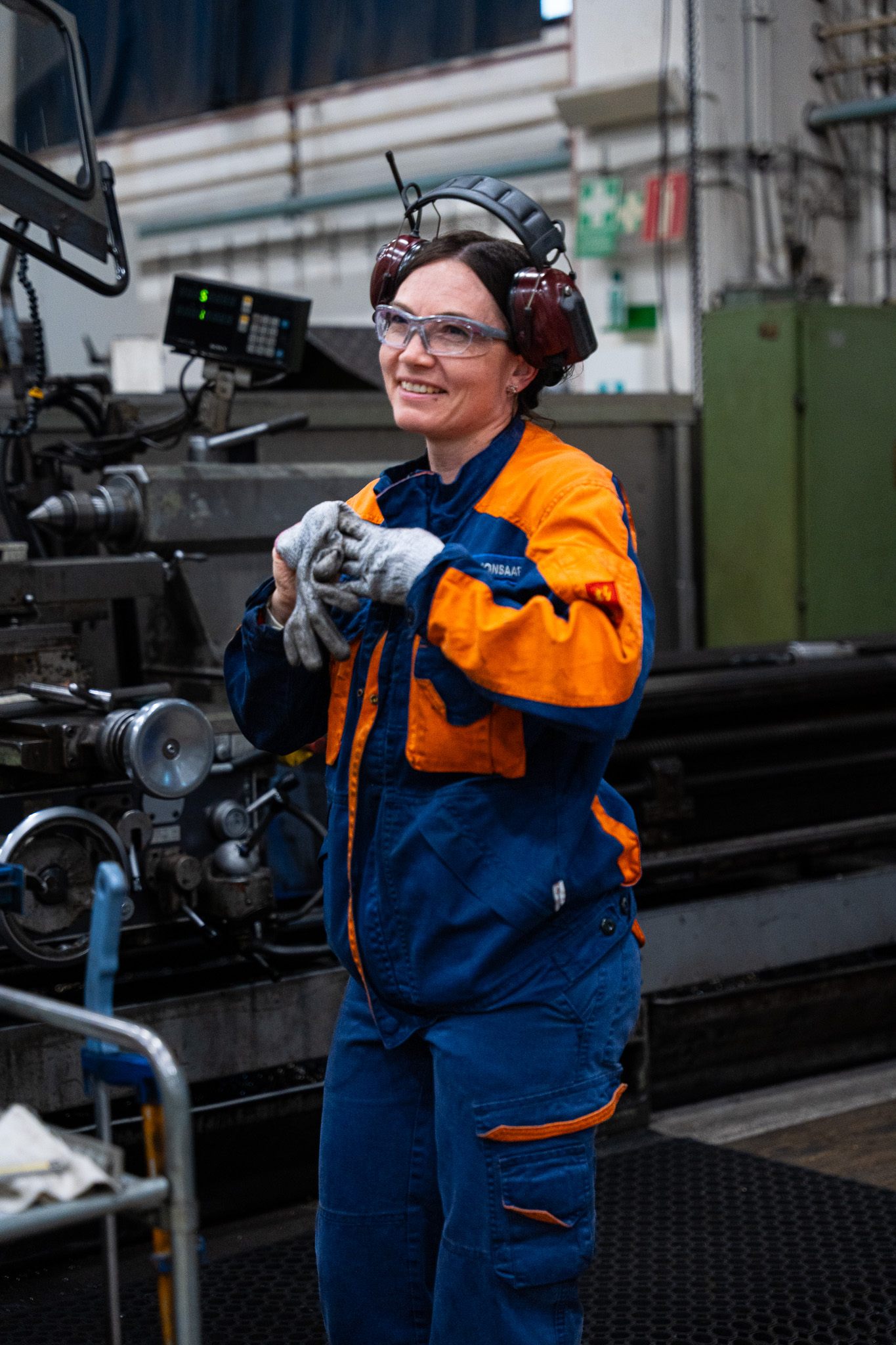
Our goal is a safe workplace with zero accidents. BMH’s responsibility for the safety and well-being of our people covers different working environments, from physical safety at our own workshop and at customer sites where our teams and subcontractors install, maintain, and operate equipment, to the psychosocial well-being in all our workplaces.
We measure workplace safety using the internationally recognised Lost Time Injury Frequency (LTIF), which counts the number of lost-time injuries per one million hours worked.
BMH committed to the UN Sustainable Development Goals
The UN Sustainable Development Goals (SDGs) provide a shared global framework for a more sustainable future. All 17 goals matter to BMH, and we have identified the ones where our business can make the greatest positive impact, and those where we work to minimise any negative impact. Our sustainability programme and its targets are aligned with the SDGs most relevant to our operations.
BMH is particularly committed to advancing three SDGs:
SDG 7 – Affordable and clean energy
SDG 7: How BMH advances affordable and clean energy
BMH’s material handling solutions are built on the principle of replacing fossil fuels with waste, biomass, or a combination of alternative fuels. Waste is generated everywhere in the world and turning it into fuel makes cleaner energy more widely available in developing regions and beyond, while addressing a global waste challenge at the same time.
BMH also advances this goal in its own operations. Our workshop runs on renewable electricity, and we continuously improve the energy efficiency of our facilities and processes.
SDG 9: How BMH contributes to industry, innovation and infrastructure
BMH’s material handling solutions enable more efficient use of resources and help reduce carbon emissions from industry and society. Waste itself serves as our raw material: our screening technologies allow recyclable materials to be recovered effectively, while the remaining fraction is turned into cleaner energy.
We also invest in higher value-added technologies and applications, such as waste-to-chemicals and advanced recycling processes, and install and commission our clean, environmentally responsible technology for customers around the world.
SDG 13: How BMH takes climate action
BMH’s core business is built on circular economy principles and renewable energy sources, contributing to both climate change mitigation and adaptation. Using waste as a raw material reduces methane emissions from landfills, enables low-emission energy production, and supports climate resilience – because the availability of waste as a feedstock is not affected by the physical impacts of climate change.
BMH has also set emissions reduction targets for its own operations and taken concrete action to meet them, including investing in renewable electricity and more energy-efficient machinery in our production. In addition, we have mapped our value chain emissions, and the next step is to set targets and plan actions for reducing them as well.
Responsibility across our global supplier network
BMH Supplier Code of Conduct
Our Supplier Code of Conduct sets out the expectations we have for all suppliers working with BMH, covering human rights, labour practices, occupational health and safety, environmental responsibility, business ethics, and anti-corruption.
From 2024 onwards, all new suppliers are required to sign the Supplier Code of Conduct before entering into business with BMH. Today, 100% of our direct purchases come from suppliers who have committed to it.
Third-party supplier risk screening
All BMH suppliers are screened against international sanctions lists by an independent third-party service as part of our ongoing supplier management. The screening also supports the identification of broader supplier risks, such as country-level risks, corruption exposure, and involvement in serious human rights violations.
Supplier audits
Regular supplier audits are part of how we manage our supplier network. In addition, we conduct dedicated Sustainability Audits for our most strategic suppliers.
Our Sustainability Audits examine several areas, including ensuring safety and well-being, respecting human and labour rights, overseeing supply chain sustainability practices, managing environmental and safety impacts, and complying BMH’s Supplier Code of Conduct.
BMH Whistleblowing channel
BMH has a whistle-blowing channel that enables our employees and stakeholders to file a confidential report if they detect non-compliance with legislation or BMH Code of Conduct.
We encourage all employees and stakeholders to report all violations through the line management, contact person or someone in the company management. If this is not possible, you can report the suspicion anonymously through BMH whistleblowing reporting channel.
BMH whistleblowing channel is not intended to replace certain existing procedures and therefore it should not be used in the following situations:
- Issues related to employment relation or dissatisfaction at the workplace: employees should contact their supervisor or the HR department.
- Customer, supplier, and partner feedback or complaints.
- Work accidents and safety observations.
- Quality deviations.
Extending equipment lifetime
The most sustainable machine is one that keeps running for decades. BMH equipment and production lines are built for long operational lifetimes, and our Life Cycle Services help keep them running – whether they were delivered last year or three decades ago.
We supply spare parts, maintenance, inspections, and technical support for every BMH machine throughout its full lifetime. Modernisations bring new technology to existing lines, extending equipment life and improving capacity, energy efficiency, and fuel quality at the same time. Each service call, spare part, or upgrade delays the environmental cost of replacing equipment and helps our customers get more value from their original investment.
Let’s continue the conversation
Sustainability is not something we do alone. We work with our customers, partners, and communities to build a renewable future together. Whether you have questions about our EcoVadis rating, our supplier expectations, or the environmental impact of our solutions, we welcome the conversation.